The short answer
- Sampled every six hours in spring, trout stomachs were fullest at noon and 6 pm and emptiest at dawn and midnight.
- The same trout ate far more in spring and summer than in autumn and winter.
- Brown trout feed at their top rate from about 7 to 19 °C (44–67 °F); above that, feeding drops sharply.
- In a January survey, the rivers we fish measured 9.9 to 18.1 °C (50–65 °F), inside that range.
- What that suggests: in cool water, the middle of the day; in a summer heat spell, early and late on the warmest rivers.
What did the feeding studies find?
The clearest data on when Patagonian trout eat comes from Challhuaco, a small forested stream in Nahuel Huapi National Park, on the Argentine side of the Andes. Researchers examined the stomachs of 190 rainbow trout across the seasons and, on a late-spring day in December 2005, every six hours around the clock:
| Time of day | Average prey items per stomach |
|---|---|
| 6 am (dawn) | 22.8 |
| Noon | 34.5 |
| 6 pm | 35.6 |
| Midnight | 20.9 |
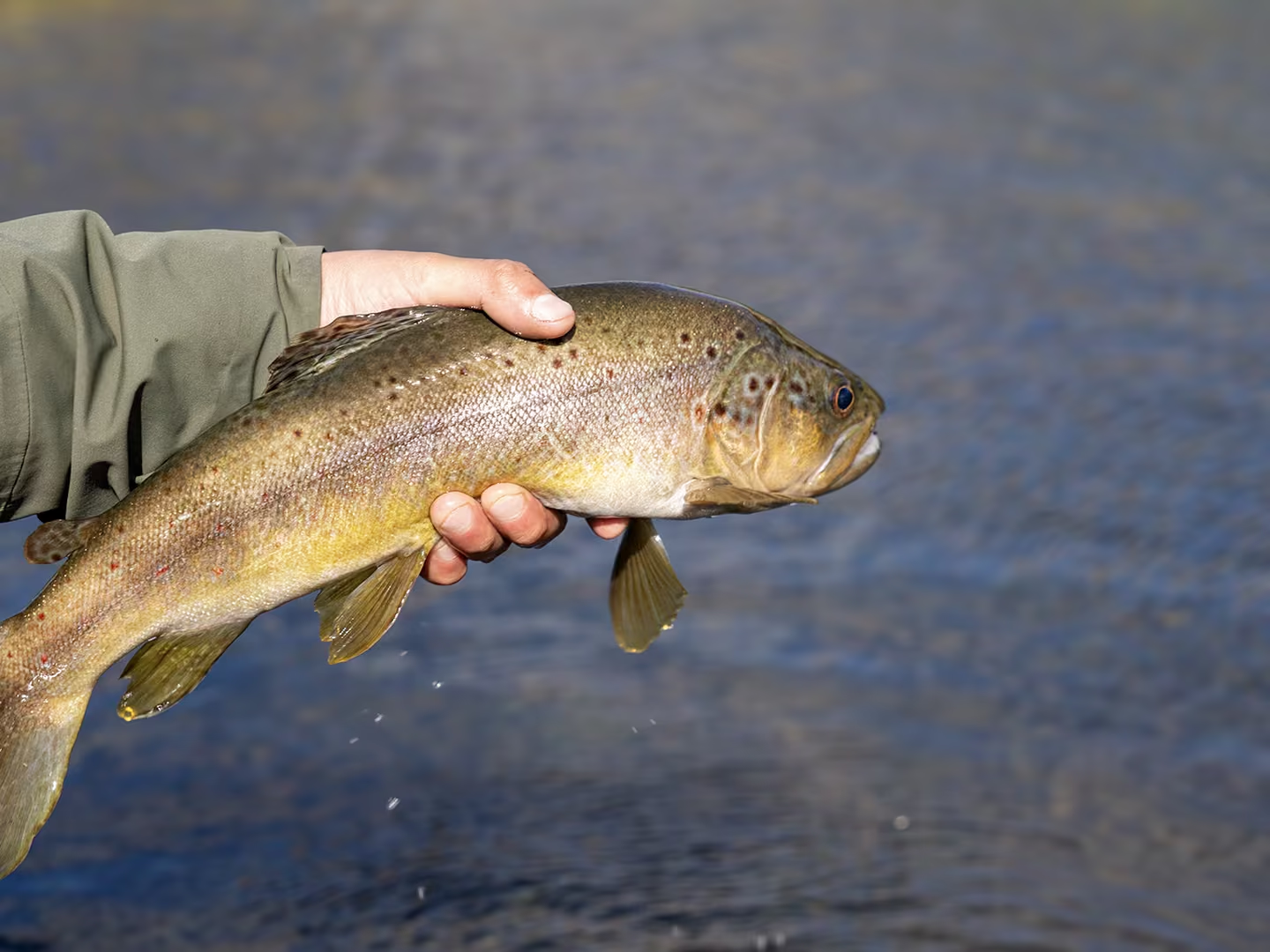
Rainbow trout in Challhuaco stream, 22 December 2005. Source: Buria et al. (2009), table 1.
The authors describe feeding that peaked at noon and before dusk, “suggesting a great light dependence.” Across the year the same population ate the most in spring (34.7 prey items per stomach) and summer (21.1), and the least in winter (14.7) and autumn (7.6). Land insects were eaten at a steady rate around the clock, so at midnight they doubled their share of the stomach, from 18% to 37% of prey items. Two cautions: these were small trout, under 18 cm (7 in), and the stream was cold, from 2 °C in winter to 11 °C in summer. Read the pattern, not the exact numbers.
How does water temperature change the picture?
The reference work on brown trout appetite is laboratory research by J.M. Elliott. The maximum feeding rate rose from 3.8 to 6.8 °C (39–44 °F), held fairly constant from 6.8 to 19.3 °C (44–67 °F) and fell markedly above 19.3 °C (67 °F). Around Coyhaique, the January 2006 survey of the Aysén basin took the water temperature of each river it sampled:
| River | Water temperature, January 2006 |
|---|---|
| Simpson | 18.1 °C (65 °F) |
| Ñirehuao | 12.4 °C (54 °F) |
| Mañihuales | 10.0 °C (50 °F) |
| Emperador Guillermo | 9.9 °C (50 °F) |
One reading per river during the survey visit. Source: Oyanedel et al. (2008), table I.
In the Palena River, in northern Chilean Patagonia, a year-round study measured 6.1 °C in winter and 16.7 °C in summer (43–62 °F), which its authors called ideal for salmonids. On a typical summer day, then, our rivers sit inside the band where trout feed at full rate. What that suggests for the heat: the Simpson, the warmest of the four that January, is the river to watch in a hot spell, because water approaching 19 °C is where brown trout start eating less; the cooler rivers and the cooler ends of the day carry the fishing then. Our river conditions page shows the latest water temperature measured by Chile's water authority.
Where do trout hold while they feed?
In the Palena River, juvenile rainbow trout were found mainly in the faster riffles and glides, while brown trout tended to favor the pools. The food follows the current: in the Aysén basin survey, the number and variety of aquatic insects fell as the water got more turbulent, and the variable that best explained where they lived was a measure of that turbulence. What lives where, insect by insect, is in what trout eat in Chilean Patagonia.
What does it mean for your day?
A guided Full Day is around eight hours on the water, and in January the daylight lasts close to 15 hours, with an evening rise that can run until about 10 pm. We watch the water on the day instead of following a fixed clock. In cold water the warmest hours usually carry the action, as in the short midday dry-fly windows of March and April; in a midsummer heat spell, the science points to the cooler rivers and the edges of the day. If it is your first guided trip, see how a guided day works.
Sources
- Buria, L.M., Albariño, R.J., Modenutti, B.E. & Balseiro, E.G. (2009). Temporal variations in the diet of the exotic rainbow trout (Oncorhynchus mykiss) in an Andean-Patagonian canopied stream. Revista Chilena de Historia Natural 82: 3–15. Read the study
- Elliott, J.M. (1975). Number of meals in a day, maximum weight of food consumed in a day and maximum rate of feeding for brown trout, Salmo trutta L. Freshwater Biology 5: 287–303. Read the study
- Oyanedel, A., Valdovinos, C., Azócar, M., Moya, C., Mancilla, G., Pedreros, P. & Figueroa, R. (2008). Spatial distribution patterns of benthic macroinvertebrates in the Aysén River basin (Chilean Patagonia). Gayana 72(2): 241–257. Read the study
- Bravo, S., Whelan, K. & Silva, M.T. (2021). Assessment of trout populations inhabiting the Palena River, southern Chile. Latin American Journal of Aquatic Research 49(1): 29–39. Read the study